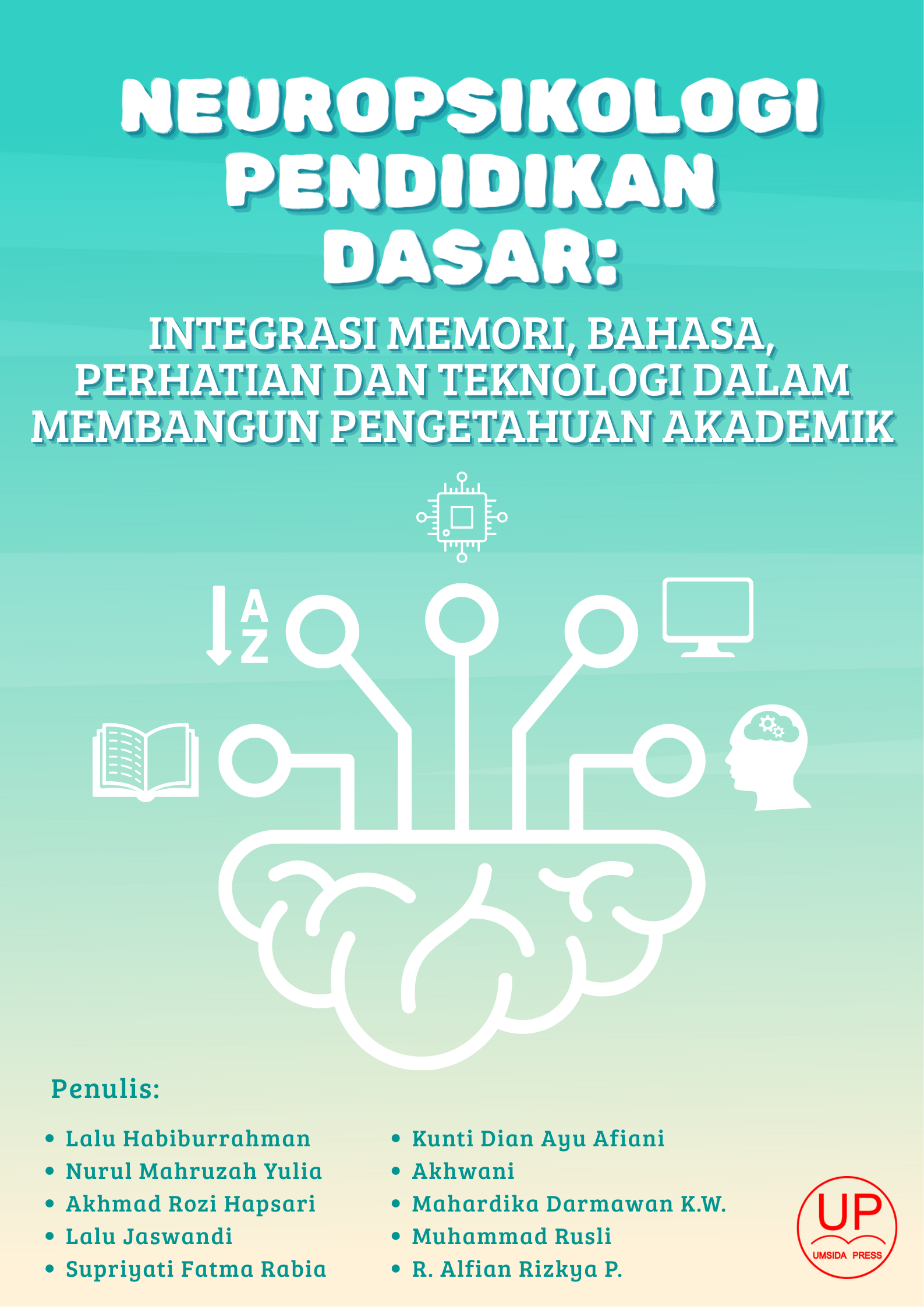
Neuropsikologi Pendidikan Dasar: Integrasi Memori, Bahasa, Perhatian dan Teknologi dalam Membangun Pengetahuan Akademik
DOI:
https://doi.org/10.21070/2025/978-623-464-132-5Keywords:
Memori Kognitif, Perkembangan Bahasa, Teknologi PendidikanAbstract
Judul : Neuropsikologi Pendidikan Dasar: Integrasi Memori, Bahasa, Perhatian dan Teknologi dalam Membangun Pengetahuan Akademik
- BAB I: PENGETAHUAN AKADEMIK
- BAB II: FAKTOR PENENTU KEMAMPUAN AKADEMIK
- BABIII: INGATAN
- BAB IV: KEMAMPUAN BAHASA ANAK SEKOLAH DASAR
Editor: M.Tanzil Multazam
Published by:
Universitas Muhammadiyah Sidoarjo Press, Sidoarjo, 2025
ISBN:
- ISBN : 978-623-464-132-5
Deskripsi :
Neuropsikologi Pendidikan Dasar: Integrasi Memori, Bahasa, Perhatian dan Teknologi dalam Membangun Pengetahuan Akademik membahas bagaimana proses-proses neurokognitif utama pada anak—memori, bahasa, dan perhatian—berperan sebagai fondasi dalam pembentukan pengetahuan akademik. Kajian ini menyoroti bagaimana otak anak memproses, menyimpan, dan menghubungkan informasi melalui memori; bagaimana kemampuan bahasa mendukung pemahaman konsep, komunikasi, dan literasi; serta bagaimana perhatian menjadi kunci dalam mempertahankan fokus dan mengelola distraksi selama pembelajaran.
Fokus Utama :
Peran Memori dalam Pembentukan Pengetahuan Akademik
- Menjelaskan bagaimana memori jangka pendek, memori kerja, dan memori jangka panjang berkontribusi pada proses belajar.
- Mengkaji teknik dan stimulasi yang membantu memperkuat retensi informasi pada anak.
Fitur Unik :
Pendekatan Neurokognitif Terintegrasi
Menggabungkan tiga domain utama—memori, bahasa, dan perhatian—sebagai fondasi pembentukan pengetahuan akademik, sehingga memberikan perspektif yang komprehensif tentang proses belajar anak.
Target Audiens :
Guru Sekolah Dasar
Untuk membantu mereka memahami bagaimana memori, bahasa, dan perhatian bekerja dalam otak anak, serta bagaimana teknologi dapat dimanfaatkan untuk mengoptimalkan pembelajaran.
Mahasiswa dan Calon Guru di Bidang Pendidikan
Sebagai landasan teoritis dan praktis dalam mempelajari proses neurokognitif yang mendasari belajar dan penerapan teknologi pendidikan.
Downloads
References
Badan Pusat Statistik (BPS). (2022). Statistik Publikasi Penelitian di Indonesia. Jakarta:BPS
Creswell, J. W. (2014). Research Design: Qualitative, Quantitative, and Mixed Methods Approaches. Thousand Oaks, CA: SAGE Publications.
Collins, F. S., Morgan, M., & Patrinos, A. (2003). The Human Genome Project: Lessons from the Past and a Look to the Future. Nature Reviews Genetics, 4(4), 325-331.
Fanelli, D. (2009). "How Many Scientists Fabricate and Falsify Research? A Systematic Review and Meta-Analysis of Survey Data." PLOS ONE, 4(5), e5738.
Gavi. (2021). The Role of Vaccines in Combating COVID-19. Geneva: Gavi, The Vaccine Alliance.
Head, A. J., & Eisenberg, M. B. (2010). "How Today’s College Students Use Wikipedia for Course-Related Research." First Monday, 15(3).
Hidayati, N. (2018). Dasar-Dasar Pendidikan Tinggi. Jakarta: Penerbit Universitas Indonesia.
Holstein, K., Wortman, A., & Hurst, D. (2019). "The Ethics of Artificial Intelligence in Education." Educational Technology, 59(3), 35-43.
Ioannidis, J. P. A. (2005). "Why Most Published Research Findings Are False." PLoS Medicine, 2(8), e124
IPCC. (2021). Climate Change 2021: The Physical Science Basis. Contribution of Working Group I to the Sixth Assessment Report of the Intergovernmental Panel on Climate Change.
______________ (2022). Climate Change 2022: Impacts, Adaptation, and Vulnerability.
Geneva: IPCC. Kemdikbud. (2020). Data Pendidikan Tinggi. Kementerian Pendidikan dan Kebudayaan Republik Indonesia
______________ (2020). "Program Anti-Plagiarisme Kementerian Pendidikan dan Kebudayaan." Retrieved from Kemdikbud
Kementerian Kesehatan RI. (2022). Kebijakan Kesehatan Terintegrasi. Kementerian Kesehatan Republik Indonesia Kementerian Riset dan Teknologi. (2021). Statistik Publikasi Ilmiah Indonesia. Jakarta: Kemenristek.
Lathrop, A., & Foss, K. (2005). "Student Cheating and Plagiarism in the Internet Era: A Wake-Up Call for Educators." The Internet and Higher Education, 8(2), 115-121 Lembaga Riset Pendidikan Tinggi. (2021). Survei Pendidikan Tinggi di Indonesia.
Lewandowsky, S., Ecker, U. K. H., & Cook, J. (2017). "Beyond Misinformation:Understanding and Coping with the “Post-Truth” Era." Journal of Applied Research in Memory and Cognition, 6(4), 353-369.
Luckin, R., Holmes, W., Griffiths, M., & Forcier, L. B. (2016). "Intelligence Unleashed: An Argument for AI in Education." Pearson Education.
McCabe, D. L., & Pavela, G. (2004). "Some Trends in Academic Integrity: A 30-Year Perspective." Journal of College and Character, 6(5), 1-7
McKinsey Global Institute. (2021). "The State of AI in 2021. PLOS. (2016). "Open Access: The Future of Research
Prabowo, A. (2020). Metodologi Penelitian Kesehatan. Yogyakarta
Resnik, D. B. (2011). "What is Ethics in Research & Why is it Important?" Retrieved from National Institutes of Health. Riyanto Andi, B. (2019). Psikologi dan Perilaku Manusia. Surabaya: Penerbit Airlangga.
Santoso, R. (2020). Gizi Seimbang untuk Kesehatan Optimal. Bandung: Penerbit
Alfabeta. Suyanto, E. (2013). Teori dan Praktik Pendidikan. Semarang: Penerbit Universitas Diponegoro.
Stanford University. (2020). "Research Integrity Training." Retrieved from Stanford.
Statista. (2022). Number of Internet Users Worldwide from 2010 to 2025
Steneck, N. H. (2006). "Fostering Integrity in Research: A New Model for Research Ethics." The Journal of Research Administration, 37(1), 1 10.
Suber, P. (2012). "Open Access." MIT Press
Topol, E. J. (2019). "Deep Medicine: How Artificial Intelligence Can Make Healthcare Human Again." Basic Books
Turnitin. (2021). "Plagiarism Detection and Prevention." Retrieved from Turnitin.
UNESCO. (2019). Interdisciplinary Research: A Global Perspective. United Nations Educational, Scientific and Cultural Organization.
UGM. (2021). Laporan Penelitian tentang Keterampilan Kolaborasi Mahasiswa.Universitas Gadjah Mada.
_____________ (2021). "Pedoman Etika Penelitian." Retrieved from UGM.
Universitas Indonesia. (2022). Program Pengabdian Masyarakat Universitas Indonesia. Retrieved from UI website
______________ (2020). Pengembangan Kurikulum Multidisipliner. Universitas Indonesia.
______________ (2022). "Pelatihan Etika Akademik untuk Mahasiswa Baru." Retrievedfrom UI.
Universitas Pendidikan Indonesia (2020). Pengalaman Guru dalam Pembelajaran: Sebuah Studi Kasus. Bandung: UPI.
Van Noorden, R. (2011). "Publish or Perish." Nature, 472(7343), 391-394
World Bank. (2020). "World Development Report 2021: Data for Better Lives.
World Economic Forum. (2020). The Future of Jobs Report.
World Health Organization (2021). Vaccines and Immunization: What is Vaccination? Retrieved from WHO website.
______________ (2021). The Role of Experts in Public Health Decision Making. Geneva: WHO
Zhao, Y., et al. (2020). "The Role of Teachers in the Age of AI." Educational Research Review, 30.
Almarzouki, A. F. (2024). Stress, working memory, and academic performance: a neuroscience perspective. Stress (Amsterdam, Netherlands), 27(1), 2364333. https://doi.org/10.1080/10253890.2024.2364333
Ankri, Y. L. E., Braw, Y., Luboshits, G., & Meiron, O. (2020). The effects of stress and transcranial direct current stimulation (tDCS) on working memory: A randomized controlled trial. Cognitive, Affective and Behavioral Neuroscience, 20(1), 103–114. https://doi.org/10.3758/s13415-019-00755-7
Aziz, R., Sidik, N. A. H., Trimansyah, T., Khasanah, N., & Yulia, N. M. (2020). Model Suasana Kelas yang Mensejahterakan Siswa Tingkat Pendidikan Dasar. Mediapsi, 6(2), 94–101. https://doi.org/10.21776/ub.mps.2020.006.02.3
Botdorf, M., Canada, K. L., & Riggins, T. (2022). A meta-analysis of the relation between hippocampal volume and memory ability in typically developing children and adolescents. Hippocampus, 32(5), 386–400. https://doi.org/10.1002/HIPO.23414
Chaddock, L., Erickson, K. I., Prakash, R. S., Kim, J. S., Voss, M. W., Vanpatter, M., Pontifex, M. B., Raine, L. B., Konkel, A., Hillman, C. H., Cohen, N. J., & Kramer, A. F. (2010). A neuroimaging investigation of the association between aerobic fitness, hippocampal volume, and memory performance in preadolescent children. Brain Research, 1358, 172–183.https://doi.org/10.1016/j.brainres.2010.08.049
Ernilah, E., Toharudin, M., Saefudin Wahid, F., Studi, P., Guru, P., Dasar, S., Keguruan, F., & Pendidikan, I. (2022). Pengaruh Lingkungan Keluarga dan Teman Sebaya Terhadap Kecerdasan Emosional Siswa Sekolah Dasar. Jurnal Ilmiah KONTEKSTUAL, 3(02), 158–166. https://doi.org/10.46772/KONTEKSTUAL.V3I02.665
Febianti, Y. N., & Joharudin, M. (2017). FAKTOR-FAKTOR EKSTERN YANG MEMPENGARUHI PRESTASI BELAJAR MAHASISWA. Edunomic Jurnal Pendidikan Ekonomi, 5(2), 76–88. https://doi.org/10.33603/EJPE.V5I2.246
Fitri, R. (2017). Metakognitif pada Proses Belajar Anak dalam Kajian Neurosains. JP (Jurnal Pendidikan) : Teori Dan Praktik, 2(1), 56–64. https://doi.org/10.26740/JP.V2N1.P56-64
Hakim, R., Lahmi, A., & Doktor Studi Islam Universitas Muhammadiyah Sumatera Barat, P. (2025). PERKEMBANGAN OTAK DAN PERAN NUTRISI DALAM MENDUKUNG PRESTASI BELAJAR SISWA SEKOLAH DASAR. Pendas : Jurnal Ilmiah Pendidikan Dasar, 10(01), 250–259. https://doi.org/10.23969/JP.V10I01.23431
Hashimoto, T., Matsuzaki, Y., Yokota, S., & Kawashima, R. (2022). Academic achievements and brain volume development in children and adolescents. Cerebral Cortex Communications, 3(4), 1–7. https://doi.org/10.1093/TEXCOM/TGAC048
Purwanto, M. A. (2016). FAKTOR-FAKTOR YANG MEMPENGARUHI PRESTASI BELAJAR KEWIRAUSAHAAN SISWA KELAS XII SMK NASIONAL BERBAH TAHUN AJARAN 2012/2013.
Rahmawati, Y. (2015). PENGARUH KONDISI EKONOMI ORANG TUA, LINGKUNGAN SEKOLAH, DAN PRESTASI BELAJAR TERHADAP MINAT MELANJUTKAN PENDIDIKAN TINGGI. Jurnal Pendidikan Akuntansi (JPAK), 3(2). https://ejournal.unesa.ac.id/index.php/jpak/article/view/13183
Simões de Almeida, R., Rodrigues, A., Tavares, S., Barreto, J. F., Marques, A., & Trigueiro, M. J. (2025). Mental Health and Lifestyle Factors Among Higher Education Students: A Cross-Sectional Study. Behavioral Sciences (Basel, Switzerland), 15(3). https://doi.org/10.3390/bs15030253
Siregar, S., Malau, L., & Siregar, G. N. S. (2022). Belajar Matematika Siswa Kelas VII SMP Negeri 6 Pematangsiantar T.A.2022/2023. Jurnal Pendidikan Dan Konseling (JPDK), 4(6), 2910–2922. https://doi.org/10.31004/JPDK.V4I6.8663
Susanti, D., Sukarnih Putri, M., & Panca Sakti Bekasi, U. (2023). Peran Fungsi Eksekutif Otak pada Perkembangan Anak. Jurnal Pendidikan Indonesia, 4(01), 22–32. https://doi.org/10.59141/JAPENDI.V4I01.1524
Suttrisno, & Yulia, N. M. (2022). Teacher Competency Development in Designing Learning in the Independent Curriculum. AL-MUDARRIS:, 5(1).
Suttrisno, Yulia, N. M., & Fithriyah, D. N. (2022). Mengembangkan Kompetensi Guru dalam Melaksanakan Evaluasi Pembelajaran di Era Merdeka Belajar. Zahra, 3(1), 52 60.
Tanguay, A. F. N., Gardam, O., Archibald, J., Ayson, G., & Atance, C. M. (2023). Using an episodic specificity induction to improve children’s future thinking. Frontiers in Psychology, 14, 1249090. https://doi.org/10.3389/fpsyg.2023.1249090
Wati, F. A., & Isroah, I. (2019). PENGARUH LINGKUNGAN TEMAN SEBAYA, LINGKUNGAN KELUARGA, DAN MOTIVASI BELAJAR TERHADAP PRESTASI BELAJAR AKUNTANSI SISWA KELAS XII IPS SMA NEGERI 1 SEWON TAHUN AJARAN 2018/2019. Jurnal Pendidikan Akuntansi Indonesia, 17(1), 112–126. https://doi.org/10.21831/JPAI.V17I1.26516
Lauren, L. S. (2025). Neuropsikologi Integrasi Fungsi Otak dan Manifestasi Perilaku. Literacy Notes, 1(1).
Maulita, R., & Suryana, E. (2022). Neurosains dalam Proses Belajar dan Memori. Inovatif: Jurnal Penelitian Pendidikan, Agama, dan Kebudayaan, 8(2), 216-231.
Dahlan, D., Lahmi, A., & Hakim, R. (2025). Integrasi Kerja Otak dalam Proses Pendidikan dan Belajar. Al-Muaddib: Jurnal Kajian Ilmu Kependidikan, 7(2), 265-278.
Hidayat, H., Nelvi, M., Rahmat, A., Fitri, Y., & Gusneti, I. (2025). Mengenal Gejala Jiwa dengan Menelusuri Proses Mental Manusia dari Pengamatan Hingga Intelegensi. Didaktik: Jurnal Ilmiah PGSD STKIP Subang, 11(02), 207-212.
Fatwikiningsih, N. (2016). Rehabilitasi Neuropsikologi dalam Upaya Memperbaiki Defisit Executive Function (Fungsi Eksekutif) Klien Gangguan Mental. Journal An-Nafs: Kajian Penelitian Psikologi, 1(2), 320-335.
Septianto, I. (2023). Memori dan Proses Terjadinya Gerak (Aplikasi dalam Permainan Engklek). Journal Olahraga Rekat (Rekreasi Masyarakat), 2(2), 7-18.
Brown, H. D. (2007). Teaching by principles: An interactive approach to language pedagogy (3rd ed.). Pearson Education.
Berk, L. E. (2018). Development through the lifespan (7th ed.). Pearson.
Cameron, L. (2001). Teaching Languages to Young Learners. Cambridge University Press.
Canale, M., & Swain, M. (1980). Theoretical bases of communicative approaches to second language teaching and testing. Applied Linguistics, 1(1), 1–47.
Chomsky, N. (2006). Language and mind (3rd ed.). Cambridge University Press.
Derewianka, B., & Jones, P. (2016). Teaching language in context (2nd ed.). Oxford University Press.
Eggins, S. (2004). An introduction to systemic functional linguistics (2nd ed.).Continuum.
Fairclough, N. (1995). Critical discourse analysis: The critical study of language.Longman.
Field, J. (2003). Psycholinguistics: A resource book for students. Routledge.
Garton, A., & Pratt, C. (2009). Learning to be literate: The development of spoken and written language (3rd ed.). Wiley-Blackwell.
Gastaldon, S., et al. (2024). Predictive language processing: integrating comprehension and production perspectives. Frontiers in Psychology.
Gibbons, P. (2015). Scaffolding language, scaffolding learning: Teaching English language learners in the mainstream classroom (2nd ed.). Heinemann.
Grabe, W., & Stoller, F. L. (2013). Teaching and researching reading (2nd ed.).Routledge.
Halliday, M. A. K. (1994). An introduction to functional grammar (2nd ed.). Edward Arnold.
Halliday, M. A. K., & Matthiessen, C. M. I. M. (2014). Halliday’s introduction to functional grammar (4th ed.). Routledge.
Hasibuan, K. (2012). Teaching Speaking As A Productive Skill. Journal of English and Arabic Language Teaching. Vol 3 No 1
Hulme, C., & Snowling, M. J. (2014). The science of reading: A handbook (2nd ed.). Wiley-Blackwell.
Hymes, D. (1972). On communicative competence. In J. B. Pride & J. Holmes (Eds.),Sociolinguistics (pp. 269–293). Penguin.
Levelt, W. J. M. (1993). Speaking: From intention to articulation. MIT Press.
Mercer, N., & Littleton, K. (2007). Dialogue and the Development of Children’s Thinking: A Sociocultural Approach. Routledge.
Martin, J. R., & Rose, D. (2007). Working with discourse: Meaning beyond the clause (2nd ed.). Continuum.
Nation, I. S. P., & Newton, J. (2009). Teaching ESL/EFL listening and speaking.Routledge.
Owens, R. E. (2016). Language development: An introduction (9th ed.). Pearson.
Pateda, M. (2011). Semantik Leksikal. Jakarta: Rineka Cipta.
Richards, J. C., & Rodgers, T. S. (2014). Approaches and methods in language teaching (3rd ed.). Cambridge University Press.
Slavin, R. E. (2014). Cooperative Learning in Schools. International Academy of Education
Snowling, M. J., & Hulme, C. (2012). The science of reading: A handbook. Blackwell Publishing.
Scarborough, H. S. (2011). Early identification of reading disabilities. In M. L. Kamil et al. (Eds.), Handbook of reading research (Vol. 4). Routledge.
Traxler, M. (2012). Introduction to psycholinguistics: Understanding language science. Wiley-Blackwell.
Tarigan, H. G. (2008). Menyimak sebagai suatu keterampilan berbahasa. Angkasa.
Vandergrift, L., & Goh, C. C. M. (2012). Teaching and learning second language listening: Metacognition in action. Routledg
Vygotsky, L. S. (1978). Mind in society: The development of higher psychological processes. Harvard University Press.
Wood, D., Bruner, J. S., & Ross, G. (1976). The role of tutoring in problem solving. Journal of Child Psychology and Psychiatry, 17(2), 89–100.
Anisah, Z. (2019). Relevansi Operasional Bahasa dengan Otak Manusia. Stilistika: Jurnal Pendidikan Bahasa dan Sastra, 12(2), 187–196. https://doi.org/10.30651/st.v12i2.2901
Amira, H. (2024). Psychological and Educational Approach in Teaching and Learning Foreign Languages. Turkish Academic Research Review, 9(3), 242–258. https://doi.org/10.30622/tarr.1466024
Azzahra, M., Gunawan, G., & Pratomo, H. T. A. (2025). Working Memory dan Pemahaman Kosakata Anak. Innovative: Journal of Social Science Research, 5(1), 6682–6691. https://doi.org/10.31004/innovative.v5i1.17568
Bautista-Vallejo, J. M., Hernández-Carrera, R. M., Moreno-Rodriguez, R., & Lopez- Bastias, J. L. (2020). Improvement of Memory and Motivation in Language Learning in Primary Education through the Interactive Digital Whiteboard (IDW): The Future in a Post-Pandemic Period. Sustainability, 12(19), 8109. https://doi.org/10.3390/su12198109
ElAdl, A. M., & Eissa Saad, M. A. (2019). Effect of a Brain-Based Learning Program on Working Memory and Academic Motivation among Tenth Grade Omani Students. Psycho-Educational Research Reviews, 8(1), 42–50.
Fikria, S. N., Rumapea, V. S. D., & Noviyanti, S. (2025). Hubungan dan Cara Kerja Bahasa dengan Otak Manusia. NUSRA: Jurnal Penelitian dan Ilmu Pendidikan, 6(1), 88–95. https://doi.org/10.55681/nusra.v6i1.3313
Harerimana, J. P. (2019). Brain-Based and Learning Theories: Application of Theories in the Classroom. European Journal of Education Studies. https://doi.org/10.46827/ejes.v0i0.2356
Hepi Andini, S., Novitasari, N., & Noviyanti, S. (2023). Hubungan Otak dengan Kemampuan Berbahasa Manusia. Innovative: Journal of Social Science Research, 3(5), 11134–11143.
Kintsch, W. (1974). The Representation of Meaning in Memory. Psychology Press. https://doi.org/10.4324/9781315794563
Nurhayati, S., Suryana, E., & Abdurrahmansyah. (2022). Neurosains dan Kemampuan Berbahasa dalam Pembelajaran. Inovatif: Jurnal Penelitian Pendidikan, Agama, dan Kebudayaan, 8(2), 232–242. https://doi.org/10.55148/inovatif.v8i2.263
Resende, E. D. P. F., Rosen, H. J., Chiang, K., Staffaroni, A. M., Allen, I., Grinberg, L.T., ... & Caramelli, P. (2018). Primary School Education May Be Sufficient to Moderate a Memory-Hippocampal Relationship. Frontiers in Aging Neuroscience, 10, 381. https://doi.org/10.3389/fnagi.2018.00381
Sankalaite, S., Huizinga, M., Warreyn, P., Dewandeleer, J., & Baeyens, D. (2023). The Association between Working Memory, Teacher-Student Relationship, and Academic Performance in Primary School Children. Frontiers in Psychology, 14, 1240741. https://doi.org/10.3389/fpsyg.2023.1240741
Sari, D. K., & Widayati, S. (2022). Peran Kemampuan Bahasa dan Ingatan dalam Pendidikan Dasar. Dalam Antologi Neurosains dalam Pendidikan (hlm. 161).
Sholihah, R. A. (2022). Language and Brain: Neurological Aspects in Language Acquisition. MUHARRIK: Jurnal Dakwah dan Sosial, 5(1), 215–228. https://doi.org/10.37680/muharrik.v5i1.1069
Syifa, S. N. R., Rahmawati, N., & Noviyanti, S. (2024). Bahasa dan Otak Manusia. Didaktik: Jurnal Ilmiah PGSD STKIP Subang, 10(4), 223–229. https://doi.org/10.36989/didaktik.v10i04.5159
Corbetta, M., & Shulman, G. L. (2002). Control of goal-directed and stimulus-driven attention in the brain. Nature Reviews Neuroscience, 3(3), 201–215. https://doi.org/10.1038/nrn755
Djamarah, S. B. (2021). Psikologi Belajar. Rineka Cipta.
Fan, J., McCandliss, B. D., Sommer, T., Raz, A., & Posner, M. I. (2002). Testing the Efficiency and Independence of Attentional Networks. Journal of Cognitive Neuroscience, 14(3), 340–347. https://doi.org/10.1162/089892902317361886
Fisher, A. V., Godwin, K. E., & Seltman, H. (2014a). Visual Environment, AttentionAllocation, and Learning in Young Children. Psychological Science, 25(7),
1362–1370. https://doi.org/10.1177/0956797614533801
Fisher, A. V., Godwin, K. E., & Seltman, H. (2014b). Visual Environment, Attention Allocation, and Learning in Young Children. Psychological Science, 25(7), 1362–1370. https://doi.org/10.1177/0956797614533801
Hmelo-Silver, C. E. (2004). Problem-Based Learning: What and How Do Students Learn? Educational Psychology Review, 16(3), 235–266. https://doi.org/10.1023/B:EDPR.0000034022.16470.f3
James, W. (1890). The Principles of Psychology (Vol. 2). Henry Holt and Company. https://doi.org/10.1037/11059-000
Khairunnisa, R., Kusumarini, E., & Riyandana, A. (2023). Pentingnya Penggunaan Ice Breaking Terhadap Fokus Belajar Siswa Kelas VD dI SDN 012 Samarinda Ulu Tahun Pembelajaran 2022/2023. Jurnal Pendas Mahakam, 8, 50–54. https://jurnal.fkip-uwgm.ac.id/index.php/pendasmahakam/article/view/1363/725
Kholid, I. (2023). Pengaruh Pendekatan Contextual Teaching And Learning (CTL) Terhadap Keaktifan Belajar Siswa. Tarunaedu: Journal of Education and Learning, 1(1), 68–82. https://doi.org/10.54298/tarunaedu.v1i1.134
Kuznekoff, J. H., & Titsworth, S. (2013). The Impact of Mobile Phone Usage on Student Learning. Communication Education, 62(3), 233–252. https://doi.org/10.1080/03634523.2013.767917
Latifah, N., & Supena, A. (2021). Analisis Attention Siswa Sekolah Dasar Dalam Pembelajaran Jarak Jauh di Masa Pandemi Covid-19. Jurnal Basicedu, 5(3), 1175–1182. https://doi.org/10.31004/basicedu.v5i3.887
Monsell, S. (2003). Task switching. Trends in Cognitive Sciences, 7(3), 134–140. https://doi.org/10.1016/S1364-6613(03)00028-7
Ophir, E., Nass, C., & Wagner, A. D. (2009). Cognitive control in media multitaskers. Proceedings of the National Academy of Sciences, 106(37), 15583–15587. https://doi.org/10.1073/pnas.0903620106
Ormrod, J., & Jones, B. D. (2018). Essentials of Educational Psychology: Big Ideas to Guide Effective Teaching. Pearson. https://www.researchgate.net/publication/352354491_Essentials_of_Educational _Psychology_Big_Ideas_to_Guide_Effective_Teaching
Pekrun, R. (2006). The Control-Value Theory of Achievement Emotions: Assumptions, Corollaries, and Implications for Educational Research and Practice. Educational Psychology Review, 18(4), 315–341. https://doi.org/10.1007/s10648-006-9029-9
Posner, M. I., & Petersen, S. E. (1990). The Attention System of the Human Brain. Annual Review of Neuroscience, 13(1), 25–42. https://doi.org/10.1146/annurev.ne.13.030190.000325
Posner, M. I., & Rothbart, M. K. (2007). Research on Attention Networks as a Model for the Integration of Psychological Science. Annual Review of Psychology, 58(1), 1–23. https://doi.org/10.1146/annurev.psych.58.110405.085516
Putra, M. R. (2024). Hubungan Pengguna Gadget dengan Tingkat Konsentrasi Belajar Pada Siswa Siswi Kelas 4-6 SD. Well Being, 9(2), 296–301. https://doi.org/10.51898/wb.v9i2.310
Rueda, M. R., Moyano, S., & Rico‐Picó, J. (2023). Attention: The Grounds of Self‐Regulated Cognition. WIREs Cognitive Science, 14(1). https://doi.org/10.1002/wcs.1582
Schunk, D., Meece, J., & Pintrich, P. (2014). Motivation in Education Theory, Research and Applications (4th ed.). Pearson Education Limited. Slameto. (2008). Proses Belajar Mengajar. Remaja Rosdakarya.
Smallwood, J., & Schooler, J. W. (2006). The Restless Mind. Psychological Bulletin, 132(6), 946–958. https://doi.org/10.1037/0033-2909.132.6.946
Sohlberg, M. M., & Mateer, C. A. (1989). Introduction to cognitive rehabilitation: Theory and Practice. The Guilford Press.
Sternberg, R. J., & Sternberg, K. (2017). Cognitive Psychology (7th ed.). Cengage Learning.
Wahyudi, I., & Neviyarni, N. (2021). Analisis Terhadap Perhatian Dan Belajar Perseptual Dalam Aktivitas Belajar Siswa. EDUKATIF :Jurnal Ilmu Pendidikan, 3(1),124–134. https://doi.org/10.31004/edukatif.v3i1.231
Alexander, P. A. (2016). Relational thinking and relational reasoning: Harnessing the power of patterning. npj Science of Learning, 1, Article 16004. https://doi.org/10.1038/npjscilearn.2016.4
Azmidar, A. (2022). Using the Concrete-Representational-Abstract (CRA) approach to improve mathematical representation ability at elementary school. Jurnal PMIPA
FKIP Universitas Lampung.
Baddeley, A. D. (2000). The episodic buffer: A new component of working memory? Trends in Cognitive Sciences, 4(11), 417–423. https://doi.org/10.1016/S1364- 6613(00)01538-2
Baumanns, L., Pitta-Pantazi, D., Demosthenous, E., Lilienthal, A. J., Christou, C., & Schindler, M. (2024). Pattern-recognition processes of first-grade students: An
explorative eye-tracking study. International Journal of Science and Mathematics Education, 22, 1663–1682. https://doi.org/10.1007/s10763-024-10441-x
Becker, K. H., & Park, K. (2011). Effects of integrative approaches among science, technology, engineering, and mathematics (STEM) subjects on students’ learning: A preliminary meta-analysis. Journal of STEM Education: Innovations & Research, 12(5), 23–37
Best, J. R., & Miller, P. H. (2010). A developmental perspective on executive function. Child Development, 81(6), 1641–1660. https://doi.org/10.1111/j.1467- 8624.2010.01499.x
Burgoyne, K., Witteveen, K., Tolan, A., Malone, S., & Hulme, C. (2017). Pattern understanding: Relationships with arithmetic and reading development. Child Development Perspectives, 11(4), 239–244. https://doi.org/10.1111/cdep.12240
Diamond, A. (2013). Executive functions. Annual Review of Psychology, 64, 135–168. https://doi.org/10.1146/annurev-psych-113011-143750
Downloads
Published
How to Cite
License
Copyright (c) 2025 Lalu Habiburrahman, Nurul Mahruzah Yulia, Akhmad Rozi Hapsari, Lalu Jaswandi, Supriyati Fatma Rabia, Kunti Dian Ayu Afiani, Akhwani, Mahardika Darmawan Kusuma Wardana, Muhammad Rusli, R. Alfian Rizkya P

This work is licensed under a Creative Commons Attribution 4.0 International License.
Authors retain copyright and grant the Umsida Press right of first publication with the work simultaneously licensed under a Creative Commons Attribution 4.0 International License that allows others to share the work with an acknowledgement of the work's authorship and initial publication in this platform.